
In Jessica Jane Charleston‘s work, the canvas becomes a threshold; part mirror, part dreamscape – where the familiar outlines of the body contort and unravel. What begins as a quiet act of self-observation quickly evolves into something more challenging. A tangle of tenderness. Her portraits are drawn, then derailed and disrupted by the arrival of symbolic creatures, shadow-selves, and mythic echoes; spontaneous revelations surfacing through the act of painting.
The tangled female figure becomes a vessel through which the many dimensions of Jessica’s self can be explored: mother, lover, friend, daughter. The tender and the furious, the confident and the uncertain. They trace the artist’s ongoing attempt to understand the complexity of being human, ultimately inviting us to do the same.

Photo by Andy Bate
Let’s start at the beginning, could you tell us a bit about where you grew up, and do you think this has affected the work you create?
I grew up in a small village in Suffolk. My parents were both teachers. My brother and I had a lot of freedom. My dad is a poet and now runs a second hand bookshop, so we grew up with a lot of books, a lot of stories.
My best friend Kadi lived next door and we spent much of our time just wandering about the fields. There was nothing else to do. It sounds idyllic, and I guess in some ways it was, but it was also claustrophobic, growing up in a village, everyone knows everyone, we lived opposite the village pub, and I always had a feeling of being watched. (Something I continue to draw on in my work, being watched as a woman) I spent a lot of time watching the dramas outside the pub on a Friday night too. This theatre.
My Grandma was a photographer, she had a darkroom in her home, the first woman with a studio I was introduced to, and through her I got into photography and filmmaking. I started filming everything when I was about 16, I’d take my camcorder round the fields and monologue different stories and poems, it also accompanied me to drug-addled teenage parties, there was a healthy mix. So, yes, I got into a happy dialogue with myself early on and that just stuck.
You now live and work in London, to what extent does this city affect your work?
The museums, the galleries, it’s all on the door step. I take it for granted that I can be at the National Gallery in 30 minutes and see some of the most beautiful paintings going, for free. Art is the church for me, that sounds dramatic, but it’s just true, I go to it religiously, and it grounds me, I am absolutely awe struck by it, by what humans have created, the endless possibilities.
You describe your art as beginning with the self-portrait, which you then “derail.” What does that derailing look or feel like in the studio?
It feels like total acceptance. It feels like telling myself all the holding in, all the angst, it all has a place and it has a use here. It’s a beautiful act of self-care. The more I lean into the “agh fuck it” side of my painting the better it becomes. Which is just not the case in any other part of my life.
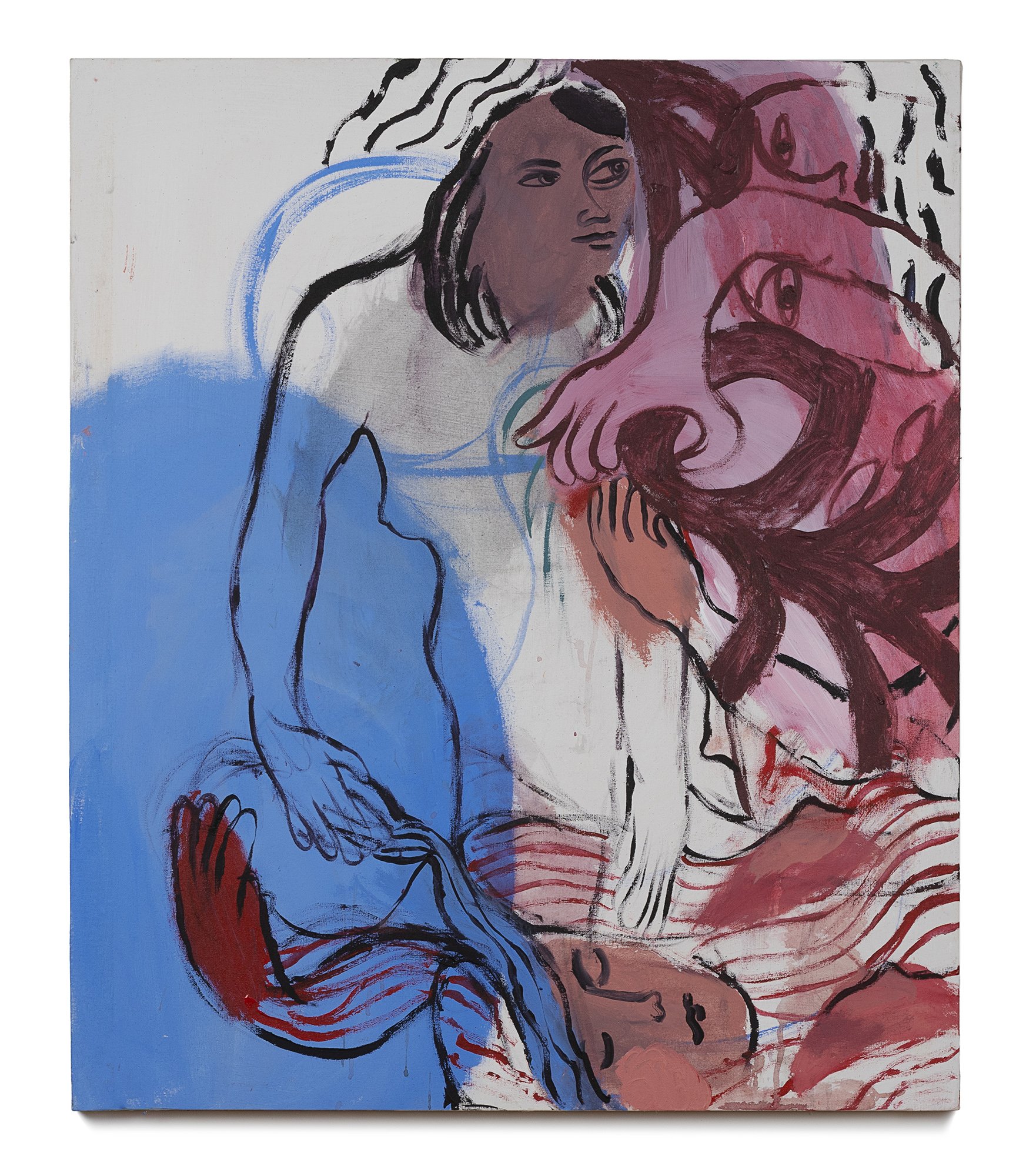

You amazingly describe yourself as “a river of mush and magic,” and we can sense that fluidity in the way your figures merge, and transform – where do you think this style comes from and what do you think motivates it?
A bit like automatic writing – when the hand is moving the mind is free to release. I begin with the curve of a hip, a claw of a hand, my tired eyes in the mirror, and allow the story, the feeling, the intrusive thoughts, the desires, to rise to the surface. Everything is of equal importance, whether I’m drawing a vase or a couple embracing, their intermingling forms, the narrative, sets the scene. I think we are all mush and magic, the unfolding of a person in conversation. The mundanity next to the enlightened.
How do you best enter the headspace where you create your art?
Probably by releasing myself from the idea that there is a right or wrong headspace to be in. That turning up daily, whether that is on the train, the sofa or the studio, is best practice for me to feel engaged with making.
The female form is central to your practice, becoming a vessel for multiple selves, roles, and emotional states. What continues to draw you to it as a focus for identity and imagination?
I’m female. I don’t know how it feels to be male. But I do know how I feel being a woman and being viewed as a woman. How that feels now and how it felt transforming from an almost gender-less innocence as a child to being informed by my gender. My parents, my mother in particular, encouraged me away from standard girl stereotypes, I wasn’t put in dresses, they kept my hair short (I was mistaken for a boy for years) I remember being a bridesmaid probably around the age of 5 or older, looking in the mirror and saying ‘I’m a girl!’ I had never identified as a traditional ‘girl’ before.


Animals appear frequently in your work – as companions, mirrors, or even extensions of the self. What do these recurring visitors reveal to you?
Oof yes big question – my upbringing, medieval art, my dreams and tarot all muddle to the surface. Horses, birds, dogs, have all had a recurring appearance in my work over the last few years. I grew up with a lot of animals (cats, dog, guinea pigs, stick insects, rabbit, a couple of chickens at some point, a giant African land snail) and now, in our sweet little shoebox of a flat in London we have no animals, although I still feel in relation to the animal-ness of my being, that’s the beauty of living alongside animals, they remind you of your animal nature, the need to stare at a fire, to curl up on a hot water bottle, for deep comfort.
I relish Medieval art, my favourite part always being the half person half beast. The bird-like creatures. Then there’s Tarot, which I love to lean into, the images riddled with animal symbolism. And my dreams; the horse arrived about 7 years ago when I dreamt my partner (who was away a lot at the time) had turned into a horse. I was in bed with the horse. It was a dark and beautiful dream, and it just stuck, the horse became this recurring symbol for the sexual, for escape and sometimes just simply as something to sit a figure upon.

Have there been any books, films or pieces of folklore that have particularly shaped your visual language?
There are a couple of myths that have stuck, that I rewind – the birth of the Minotaur (what disgusting delicious joy this is) and the story of Wayland the Smith (the imprisoned artist breaking free on wings he has crafted) some stories, some images just stick, and these two are embedded in my visual language and excitement.
Your palette is both subtle yet strong and emotionally charged – how do you think about colour when building atmosphere and tension in your paintings?
I love that. Yes. Emotionally charged colour. I am very sensitive to light and colour. I remember when I was studying at the Royal Drawing School and I was overthinking how to use colour. I was working with a box of chalk pastels. One of the tutors came over and said think of them like a box of sweets, which ones do you want. So simple, but so effective. That “urghhh yesss”, the pop of pink next to the sludgey green, you just know when it does the thing.


Many of the figures in your work appear entangled – embracing and merging into one another. Where does this come from and what does intimacy mean in your visual world?
The entangled bodies definitely stemmed from becoming a mother. Becoming one with another body. This being growing in my belly. Then this creature sucking milk from me for three years. Then us still now, the three of us, entangled, in love, in routine, in trying to get out of the front door on time. That’s a starting point. But it has mutated. The figures these days feel like the different parts of my personality. The second figure arrives as my shadow self but it also arrives as my most comforting companion. It can be the place in me where I find home. The second figure can embrace, can forgive. Or other times the second figure can grip the hair of the first and move it around like a little puppet. Yes – intimacy. The naked intimacy of it all. I will play with that forever.
How does your life as a mother inform your work’s exploration of care and identity?
All parts of myself, my family, my life, wind their way into my work. My child is 5 now. I’ve been a mother for 5 years, and it is a beautiful and dramatically different existence to the one I had 5 and a half years ago – learning to look after something so completely, I have transformed into a different creature, a mother, I became two people for nearly 9 months, this most magnificent and mundane act of creation, whether I want it to or not, lives in the work. My child is at the top of the list, the being I navigate my time around, the work is informed by this way of being in the world, but not in any planned out way.
Has your relationship to the self-portrait changed, especially as your life roles evolve?
When I was 16 I had my first life drawing class and fell in love with drawing the figure, especially drawing the naked figure. I soon realised I was the most constant model, and this is when I began regularly drawing self-portraits. The self-portraits became more interesting when I was naked of course, and felt very liberating and almost like I was conjuring up other characters (this feeling remains in my work). The self-portraits I made in my twenties were about grappling with beauty and sexuality, and I find there’s an element of performance in a self-portrait that is unavoidable. When I returned to drawing the self-portraits after my child was born, I drew myself breastfeeding, tired, but I found I still brought this bravado I’d been in relation with for a long time when making self-portraits. This is an interesting merging – the mother and the mother’s sexuality. Although I often begin with the self- portrait, I see them as a stepping stone to other characters, other parts of myself, my thoughts, stories to play with.

Where is your sanctuary?
I find sanctuary in the work – returning home to this place, my line of enquiry, of rest, purging, curiosity and complete acceptance. This really became a way to live when I was a teenager and struggling with being in the world. Being a crippling shy being. I spoke to Chantal Joffe after her talk the other night at Peckham Pelican, she was saying there has to be some kind of pay-off for walking round the world as such a sensitive person. With anxiety, or maybe you were bullied at school – that the art, the creating, is the pay off. That pay off, that sanctuary, is available to all of us.
My partner Jonny and our child are sanctuary and home. We’ve moved so many times in the last 5 years (since our child was born). Home has definitely become these two beings rather than a place. But one of the most grounding places and sanctuary I return to is the village I grew up where my parents still live. The deep nature, the quiet in contrast to our busy road London.
What are your hopes for the future?
Next year I hope to simplify and expand my practice, and my life! I am currently well and truly easing into the end of 2025. This year I had my first international solo show with CULT Aimee Friberg gallery in San Francisco. I feel very connected and excited about continuing to work with them. I’m not one for talking about future art plans because in my experience, once I’ve nailed it to the fence, I’m completely turned off by the idea. A helpful reframe in my thinking recently has been to think about my relationship with my work, long-term – hopefully I will still be painting in my studio (ideally at the bottom of a garden) when I’m in my 90s, and I want to support myself as best I can to make this happen. When I look back over my life I’m not going to remember the specific exhibitions but rather the deepening of this relationship. This sacred place.